John Aubrey’s Natural History, Part 10: Trees
The importance of Aubrey's Natural History manuscript in the history of natural history is considerable and has not been sufficiently recognised. In part, this poor recognition has been due to John Britton's 1847 edition of the work, which handled the text so poorly, and in part to its unfinished character; the mixture of precise observation, unresolved queries, embedded medicinal remedies, and personal reminiscence, which resists easy summary. But, read Aubrey's chapter on plants carefully, and it reveals its author as a figure of genuine significance in the development of British botanical science.
Aubrey opened his chapter on plants by wishing 'that we had a survey or inventory of the plants of every county in England and Wales.' In Wiltshire the soil was varied and consequently a great variety of plants grew there. 'Experience hath taught us that some plants have wonderfull vertues: and no doubt all have so; if we know it; or could discover it.' He admitted, somewhat modestly as it would turn out, he was not a botanist, few were, but proposed that apothecaries across Wiltshire could survey their area as they had the necessary knowledge; 'the taske, being divided, would not be very troublesome; and, besides the pleasure, would be of great use.' The proposal was not realised, but Aubrey had identified the right method a generation before such projects became routine.
Despite this unrealised ambition, Aubrey created his own plant inventory of approximately 150 distinct species, precisely located across the county and beyond — herbs, wildflowers, ferns, fungi, shrubs, and trees. Several entries are records of species that are difficult to find in major botanical works of the period. There are also entries for exotics, including pineapple, tobacco or henna growing at home or abroad.
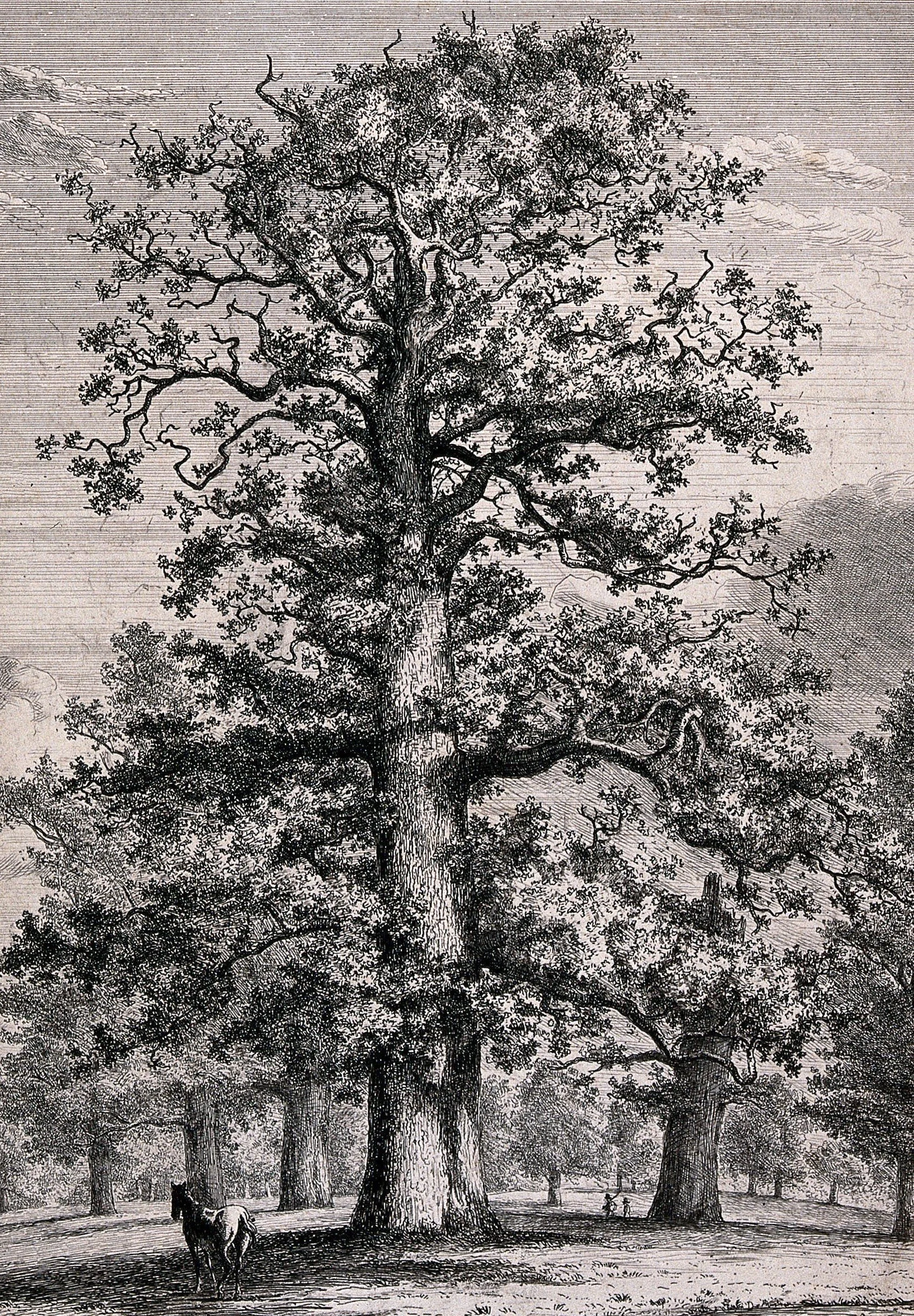
Aubrey's section on trees is particularly rich, imbued with folklore and shaped by memory and loss. He cared deeply for trees. Oaks had once been plentiful in north Wiltshire but had dwindled due to disafforestation. Box trees had once grown naturally in the parish of Box, giving it its name; by his time, they were ‘worn out’. The pine grove at Pinhill near Calne, which had given its name to the house, was reduced by 1656 to four or five trees. They had formerly ‘made fine shew on the hill’. Some specimens Aubrey knew well: the yew that had spread its shade over the churchyard at Yatton Keynell, where the boys had played in his childhood had been lopped by the minister ‘to make money of it to some bowyer or fletcher, and that lopping kill’d it. The dead trunke remaines there still’. The ancient Tortworth chestnut in Gloucestershire had stood since the reign of Stephen and reminded him of the story of Romulus and Remus. The great oak at Woodhouse, Somerset, had seen 13 men hanged by Sir Francis Dodington in its branches in the aftermath of a Civil War siege in 1644, thus witnessing an act of butchery.
Beyond that, trees had practical uses aside from their value for timber, a purpose for which Aubrey made scant reference save in the negative. Berries could be used to colour leather, leaves to set dye, nuts to sell for food and twigs for weaving. He reported the use of trees in folk remedies, such as birch sap for scurvy or willow bark worn around the neck for fits and convulsions. Trees were magical: the use of a stick of elder tree as a charm against saddle sores was widespread. Perhaps, in Aubrey’s mind, so often short of money, trees were most important as indicators of minerals underground, such as holly for coal, or the potential of the soil for other uses, such as elder for vines, an expression of the interconnectedness of all things.
Aubrey knew that tree cover and species had changed over millennia. He noted both where trees were and where they were not- recording that there were no hornbeams in the west of England; no chestnuts at all in Wiltshire and no birch trees in north Wiltshire. He recorded differences in the characteristics of species in different places, and that some species preferred certain soil. He noted oddities, east of Basingstoke two ashes were ‘married together in the shape of a capital Roman H’. He conjectured close kinship between species, noting that the medlar and service tree belonged to the same botanical ‘tribe’. He suspected beech woods may have covered Salisbury plain. But it is his treatment of elms that best demonstrates his method. He had noticed something that, as far as I know, no one else recorded to that point: he had never seen an elm growing spontaneously in a wood, as oaks, ashes, and beeches did. From this single observation, he suspected elm trees were not indigenous and built a careful argument. He eliminated the Saxons as the introducers as there were no elms in Saxony. Nor the Danes as there were none in Denmark. Nor the French as none grew wild in France. But in Italy, he noted, elms grew naturally, particularly in Lombardy. His conclusion was that the Romans had brought them to Britain, as deliberate ‘cultivators of their colonies’.
Aubrey tested this hypothesis during a journey to Durham in 1687, observing elms along the way. From London to Stamford, they grew in almost every hedge. From Stamford north he saw none, a distribution broadly consistent with the limit of intensive Roman settlement and agricultural development, and further support for his hypothesis. He reported his findings to John Ray, the greatest botanist of the age. Ray told him that when he had travelled north he had not noticed, being chiefly intent on herbs, and that he believed the contrary. Aubrey held his ground: 'it is matter of fact and therefore easily to bee prov'd.'
Modern botany has broadly confirmed Aubrey's hypothesis. The English elm is now believed to be an introduction likely by the Romans and spread through vegetative propagation, which explains why it never seeds itself naturally in woodland. Aubrey reached this conclusion not through classical authority or received wisdom but through direct observation and systematic elimination. It is one of the clearest examples in the entire Natural History of his method at its best.
There is a melancholy postscript to the story of the elm tree that he could not have anticipated. The elms he observed so carefully in every hedge from London to Stamford were devastated by Dutch elm disease in the 1970s. His record of their distribution is now a historical document as much as a botanical one.
Aubrey’s plants chapter, and indeed the whole manuscript, deserves a place in the history of British botanical science. and the forthcoming edition is the first time it has been possible to read it whole. There are many discoveries to be made in the text by those more adept than I am, and I look forward to learning more.