John Aubrey’s Natural History, Part 8: Witchcraft
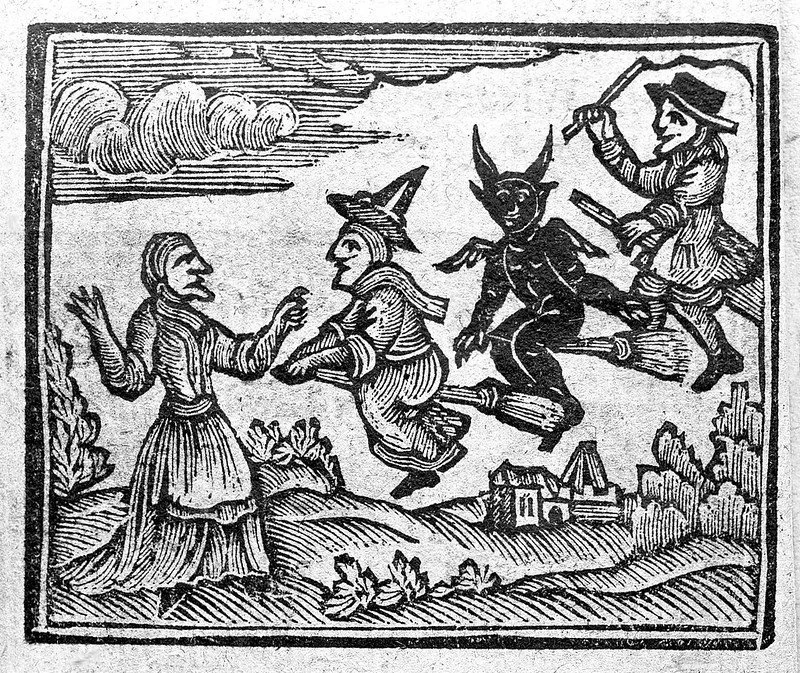
John Aubrey was not a witchfinder, not a demonologist, and not a sceptic; but he was someone who brought to witchcraft the same empirical habits of mind he applied to moles on a downland or frost crystals in a window. The question was open, and in the Natural History he simply presented the evidence.
Anne Bodenham is possibly the most notorious of the convicted witches from Wiltshire. She was executed in 1653. She had worked as a cunning woman and a teacher for several years at Fisherton Anger just outside Salisbury. The case against her was written up in pamphlets, books, and ballads. Some of the details were fantastical; Anne was a shapeshifter and could become a cat, a lion, a dog, or a bear. She had made a pact with the devil. She could summon demons. However, it is clear from Aubrey’s notes on the case that he was ambivalent about the trial process and possibly the evidence presented. His account began, ‘About 1649, one Mris Bodnam of Fisherton Anger, a poor woman that taught children to read, was tryed for a witch at Salisbury before the Chief Baron Wyld and was executed. Evidence against her was that she did tell fortunes and shewed people visions in a glasse, and that a maid saw the devill with her, with whom she made a contract, and that she knew ‘twas the devill by his cloven foot: that a boy was carried in the aire to a place covered with snow to gather certain plants, and that a black bore did shew where he should dig for them. These herbs were for a philre.’ Aubrey then noted the account of lawyer, Anthony Ettrick, ‘a very judicious gentleman’ who watched the trial and was not satisfied by the process. The judge could not hear Anne because of the furore in the courtroom. Nor could Anne hear the judge. Messages were handed ‘from one to the other’ but sometimes ‘not truly reported’. Anne was found guilty and hanged; Aubrey recorded that the proceedings were procedurally flawed. However, this was not a statement that witchcraft was impossible, or the case was necessarily false, but that this particular conviction was unsafe.
The same sceptical instinct surfaced in his notes on a cabal of witches detected at Malmesbury some years later. Aubrey noted ‘odd things <were> sworne against them, including flying in the air on a staff and the strange manner in which a horse died, the emphasis on sworne carries a faint sceptical weight; but Aubrey did not say they were innocent. He went on to suggest that the examinations of the accused and the sworn testimonies against them were in a book written by Sir James Long, a book which Long promised to the Royal Society. The appeal to institutional record is itself a statement: these matters should be examined with the same rigour as any other natural phenomenon.
Witchcraft was not only a matter for the courts. In the reign of King James I, somewhere in or around the Fonthill estate in south-west Wiltshire, there lived a man named Cantelow who was reputed to be a great wizard. Cantelow had fallen out with the church minister of Orston, Aubrey says, or near Orston, a place that might refer to Orcheston on Salisbury Plain. Shortly after the quarrel, the minister began to hear, every night as he lay in his bed and settled toward sleep, the sound of a great passing bell tolling inside his chamber chimney. Outside the door, nothing was heard. The sound was audible only to the man alone in his room, night after night, for months, to his great vexation. The implication would have been unmistakable to anyone in early modern England; someone wished him dead. This was, on the face of it, maleficium or black magic, magic used to do harm. Aubrey, characteristically, did not stop there. He recorded a proposed explanation: the sound might have been produced by a ‘great virginal wire’, stretched taut and concealed, presumably vibrating in the chimney to produce a sustained resonant hum. It is a precise and ingenious hypothesis, the kind of practical thinking that Aubrey admired. But he left the tale ambiguous; the truth 'was never discovered.' The story did not end with Aubrey. A similar account was recorded later in the eighteenth century, this time placing a wizard named Cantelow at Devizes and the details are striking: once again a church minister, once again a tolling bell heard alone in his bedchamber. The account came from the son of the lord of the manor, recalling in old age events he had not himself witnessed; testimony at one remove, carried across time by memory alone. The relationship between the two tales has yet to be established.
Aubrey took witchcraft seriously, but on his own terms. The theological framework that shaped most educated opinion on witchcraft was not easily set aside. 'Thou shalt not suffer a witch to live' commanded Exodus, and the Bible furnished numerous other examples of demonic agency, familiar spirits, and dealings with the devil. To deny witchcraft entirely was, for some, tantamount to doubting scripture itself. Many educated men of Aubrey’s generation, therefore, either believed within that theological framework, which provided a ready explanation, or dismissed it within a rationalist framework that required none. By the time Aubrey was writing, a serious debate was already underway over whether witchcraft existed at all — a debate that would, within a generation, be largely settled in favour of the sceptics. Aubrey occupied a less than comfortable position in this debate. He collected cases, as he did everything else in the Natural History, and left the verdict open when the evidence was inconclusive. That openness was unusual and, in some ways, characteristic of the early scientific revolution: a willingness to collect and suspend judgement rather than conclude. But to the more sceptical minds of the early eighteenth century, it appeared merely credulous, and it did lasting damage to his posthumous reputation.