Lancelot Morehouse & the Beast of Little Langford
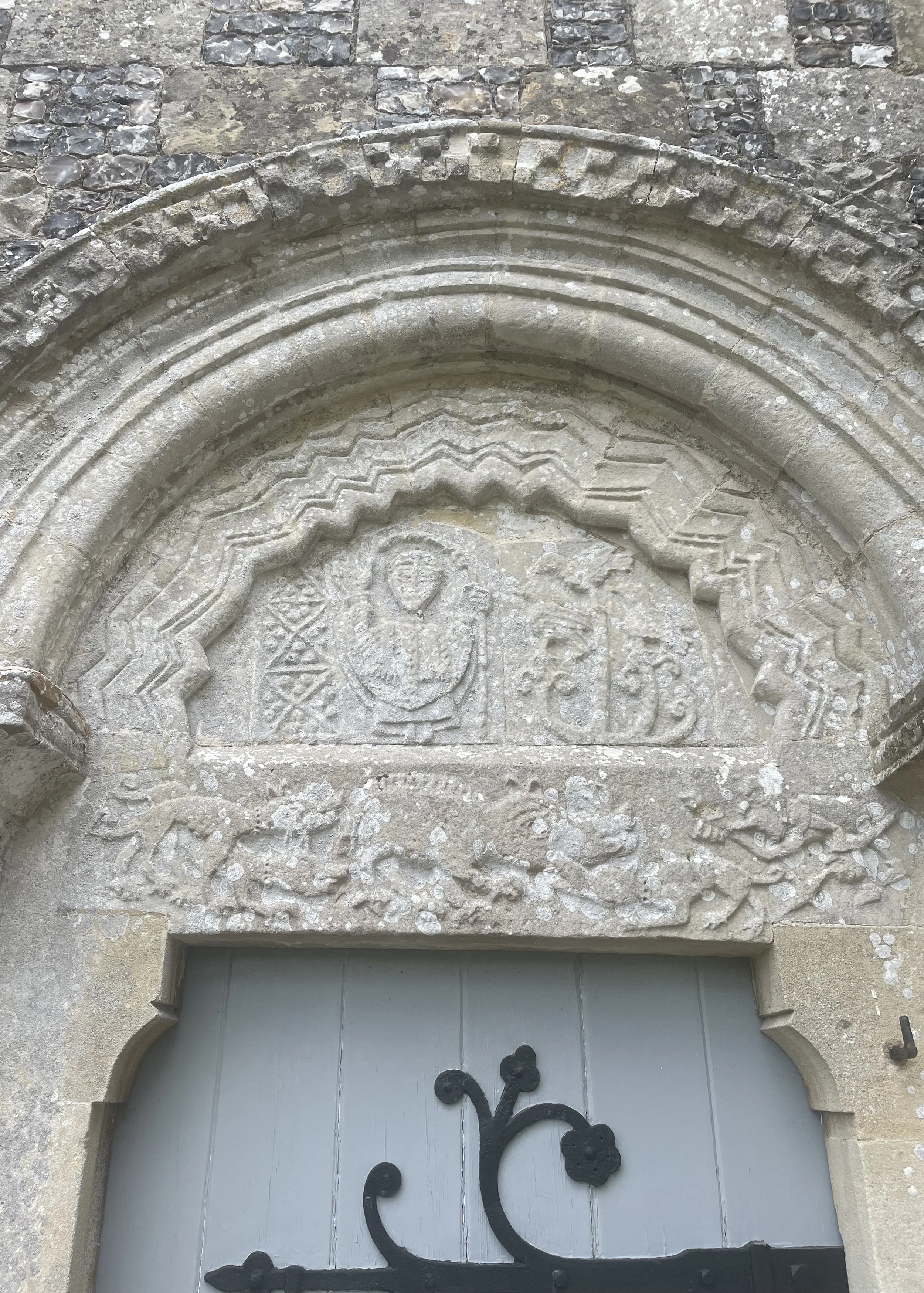
Church door at Little Langford, Wiltshire
Lancelot Morehouse was a mathematician and clergyman of exceptional intellectual range, marooned, probably by the accidents of the Civil War and its aftermath, as the rector of the small south Wiltshire parish of Little Langford from 1660; a living that was entirely (according to his friend John Aubrey) inadequate to his abilities. In other respects too Morehouse was not a typical churchman. For one, like Aubrey, Morehouse was interested in the occult. He drew a Star of David at the top of his letters; a symbol associated at the time with learned occult and alchemical traditions. He was a man willing to stake his personal and professional integrity, 'super verbum sacerdotis', on having heard something behind a hedge that no human voice could have produced. And he had once rescued a sheet of parchment from a tailor's scissors that contained prophecies written in Latin verse that predicted the 'late troubles' of the Civil War, which he had given to the Bishop of Salisbury.
Furthermore, he had challenged the mathematics of a celebrated book interpreting the Number of the Beast (666) from the Book of Revelation. Here was a man who combined conventional Anglican practice with serious engagement with occult philosophy. Finding himself at Little Langford, Morehouse turned his considerable intellect to the carved stone relief over the porch door of his own church and to the stories local people told about the beast it depicted.
According to Morehouse's friend, John Aubrey, the carving over the door looked like 'the figure of a beast, something like a boare'. However, the back of the beast was not bristled like a real boar's but invecked; scalloped or notched in the manner of heraldic decoration. Its hooves were not cloven in two, as a boar's hooves would be, but divided into three or five. Alongside the mysterious beast stood a mitred bishop with his hands raised, hunters with their horns, trees and birds. These, Aubrey understood, signified Grovely; the great forest running along the ridge directly above the church. Whatever was depicted here had happened in that forest. Someone had thought it important enough to carve in stone over the church door, where it would be seen every Sunday by every parishioner for generations. 'This must be in memory of some considerable hunting of this strange beast,' Aubrey concluded, adding 'which I have a conceit, was a wild boare.'
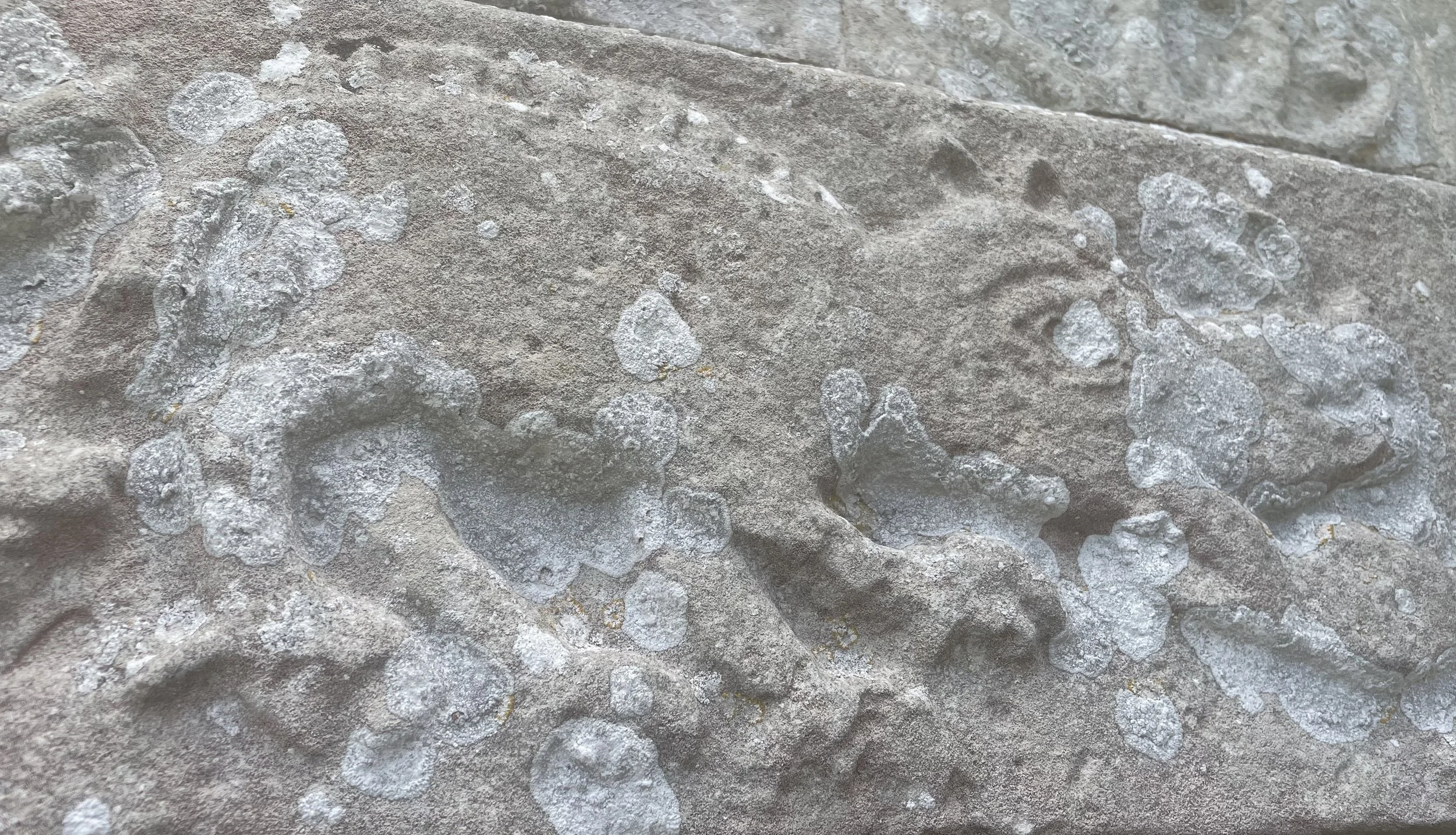
Close-up of the beast of Little Langford
But then he asked Morehouse. Morehouse brought the same precise analytical intelligence to a carved stone that he brought to the quadrature of the circle, to the authentication of a Latin prophecy, and to the assessment of a supernatural laugh. He looked at the carving carefully, applied his knowledge, and asserted the beast could not be a boar, 'for his hooves are not of a boar, nor his back, nor his snout.' He was right in his anatomical objections. Whatever the Little Langford beast was, it did not match a boar on any of these counts. With the boar identification ruled out in Morehouse's mind, and no better learned explanation available, local tradition suggested another answer.
Someone hereabout, the story went, had found an extraordinary maggot in a nut. They kept it and fed it on more nuts, and it grew into a creature of monstrous size. It escaped at last into Grovely Forest and became terrible to the neighbourhood. 'Thus', said Aubrey, 'the height of antiquity ends in fable, and the depth of ignorance descends to credulity.' To Aubrey the medieval carving was a narrative scene, real enough to be carved in stone by someone who knew what had happened and wanted it remembered. The maggot story was a folk memory that had filled the gap left by the waning of the original knowledge. Centuries of oral transmission had transformed whatever the beast was into a myth about a giant maggot beast that ate nuts.
Morehouse's interactions with Aubrey reveal him to be a careful observer and ‘indefatigable’ when it came to problem-solving. Here was not a man who would settle for the maggot legend. Morehouse had said the beast was not a boar. Yet, he could not say what it was. When he died at Little Langford around 1673, the question appeared still unanswered. His will records his wish to be buried in the chancel of his church but we do not know if he ever found a better explanation for the beast over the church door.
But perhaps the answer was there all along. Historic England's assessment of the doorway describes the lintel as a boar hunt rendered in stylised twelfth-century Romanesque carving; meaning artistic convention took precedence over zoological accuracy. Morehouse's anatomical objections, however precise, were misapplied; the carving was never intended to be naturalistic. Aubrey's instinct that it was a wild boar was right after all. The height of antiquity, it turns out, does not always end in fable. Sometimes it ends in a boar hunt, carved in stone over a church door, waiting for someone to look at it in the right way. Sorry Morehouse.