Anne Drew: the Forgotten Lord of the Manor of Ledbury
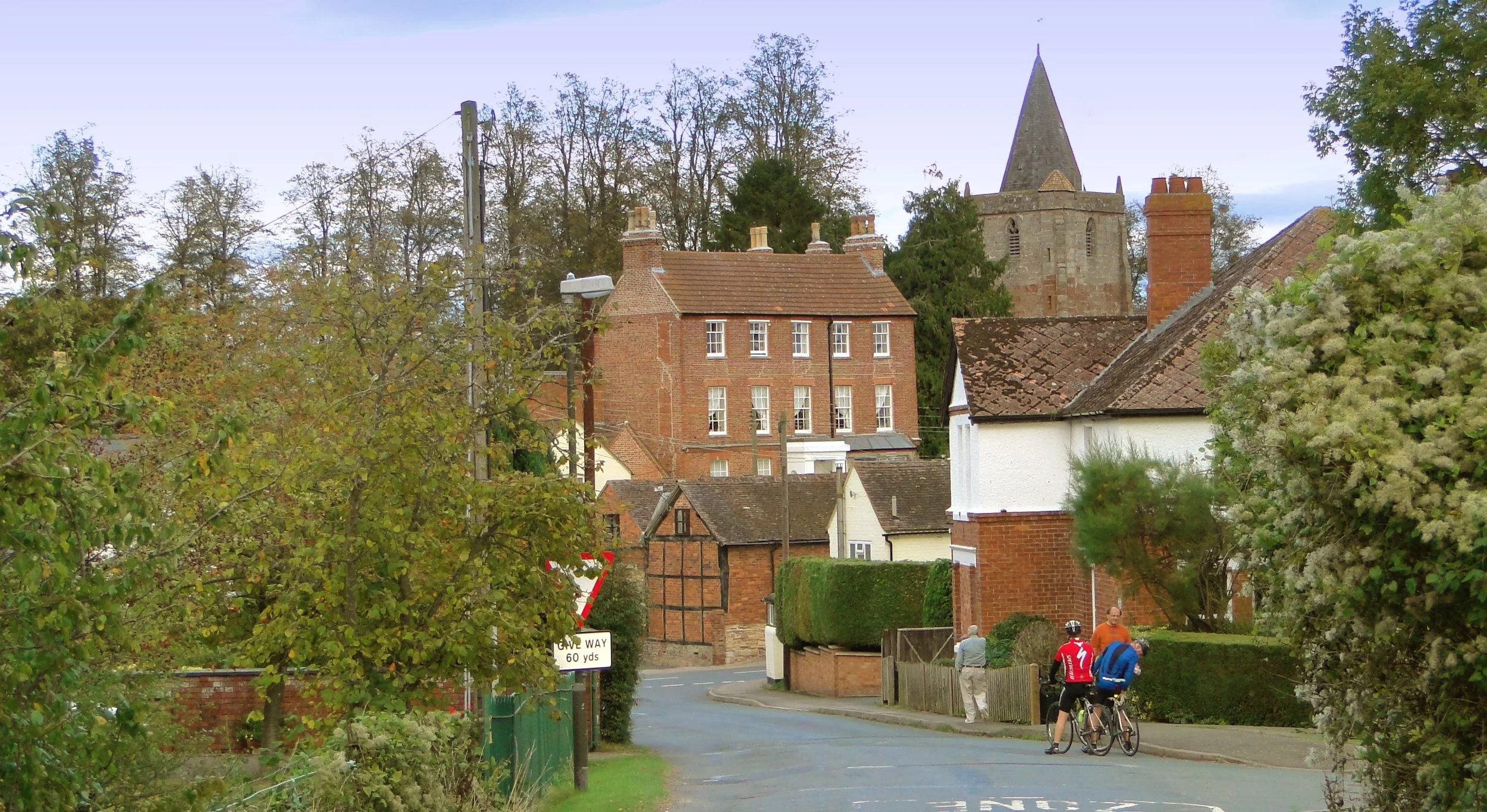
Dymock, Gloucestershire. Philip Pankhurst / Dymock Village / CC BY-SA 2.0
In the early 18th century, a strange chain of events made a farmer's wife from Dymock in Gloucestershire the lord of the manor of Ledbury.
To understand how this happened, we need to go back a few hundred years. The manor of Ledbury, comprising the borough and 1000s of acres of farmland, woodland, and waste surrounding the town, was held by the bishops of Hereford throughout the medieval period. Under Elizabeth I, this valuable estate passed to the Crown. And, for the next few decades, it was managed by a steward on behalf of the monarch, before being leased to a group of trustees in 1617 for the benefit of the Prince of Wales. In 1628, during a period of financial crisis for King Charles I, the manor was assigned to the City of London, which sold it in December 1629 to a group of men from Ledbury for £1,400. The sale was completed the following June.
Thus far the arrangement sounds straightforward. However, unlike the conventional pattern of single lordship, after 1629 the manor had multiple lords simultaneously, each holding a share in the joint proprietorship. This arrangement created an unusual overlap of roles. Several of the lords, called 'contractors', were also customary tenants of copyhold land within the manor. As lords they collectively owned the manor; as tenants they held copyhold parcels from that same lordship. As confusing and complicated as the arrangement sounds, the organisation of the manor was even more convoluted. The estate was administered through a small group of largely non-resident trustees who acted on behalf of the contractors and held the residue of the leasehold title which was due to expire in 1715/6. The men, John Drew and Guy Wilce, both from Dymock in Gloucestershire, and Thomas Stone (from Bromsberrow, Gloucestershire) and Adoniah Mutlow (from Bosbury, Herefordshire) were yeomen. Manor courts were presided over by a steward acting on their behalf. Drew, Wilce, Stone and Mutlow were in this formal sense lords of the manor. Over time as they died off, four lords became three and then two, until 1657 when a new conveyance placed the manor in the hands of four new trustees, including John Drew (likely the son of the original John Drew) and Richard Drew, both yeomen from Dymock.
As before, the new trustees passed away over time, and by 1698 there was a single lord in whose name the manorial court conducted its business: Richard Drew.
Richard Drew died in 1706, after which a new name appears in the court headings. That name made me stop in my tracks, because the new lord of the manor was a woman, Anne Drew.
Anne's position was legally precise and worth understanding. Anne was described in the court headings with careful legal specificity as 'executrix' for Richard. She held the court in that capacity as the person Richard had chosen to administer his estate, which included his share in the formal lordship of Ledbury manor. In his will, proved in October 1706, he named her his 'full, whole and sole executrix'. It was a deliberate choice over an automatic right of inheritance that widows in collective lordships simply did not have, and one that placed his entire estate, and with it his share in the lordship, in her hands alone. As the last surviving trustee, Richard had been the only lord of the manor of Ledbury. Anne now had full legal authority to hold the courts and exercise all the rights of the lordship that he had enjoyed.
The manor court met at least once a year, sometimes more, in two distinct sessions: one for the borough of Ledbury (the 'Denizen' court) and one for the surrounding farmland and settlements (the 'Foreign' court). As the lord of the manor, proceedings were conducted in Anne’s name though the actual business was supervised by the steward, Thomas Bridges, who had been serving in that role since at least 1675 and would continue to do so throughout Anne's tenure. Many of the sessions were routine, involving the transfer of tenancies, the appointment of manorial officers, and the presentment of minor misdemeanours such as encroachments and property out of repair.

The Ledbury manor court recording was normally in Latin, but Anne Drew is referred to here in English as the lady of the manor. Source: Hereford Archives and Record Centre, AF4/2. Reproduced with kind permission.
As lord of the manor, Anne was likely a woman in her 70s; she had been married to Richard for five decades. Now on his death, she was the lady of the manor of Ledbury and running their leasehold farm in Dymock with their son, John. The farm was mixed and seemingly self-sufficient: a few cattle, sheep and pigs, acres of arable and orchards. The farm, Bellamys, produced cider, perry, cheese, bacon and beef. The women of the house span wool. This may have been a modest working farm, but the Drews were literate and clearly had pretensions to gentility: they possessed a clock, a luxury item in a yeoman household of this date, owned books and a map hung on the wall in the hall. The farm occupied a medieval moated site; though the farmhouse was rebuilt after Anne's tenure, the moat survives today.
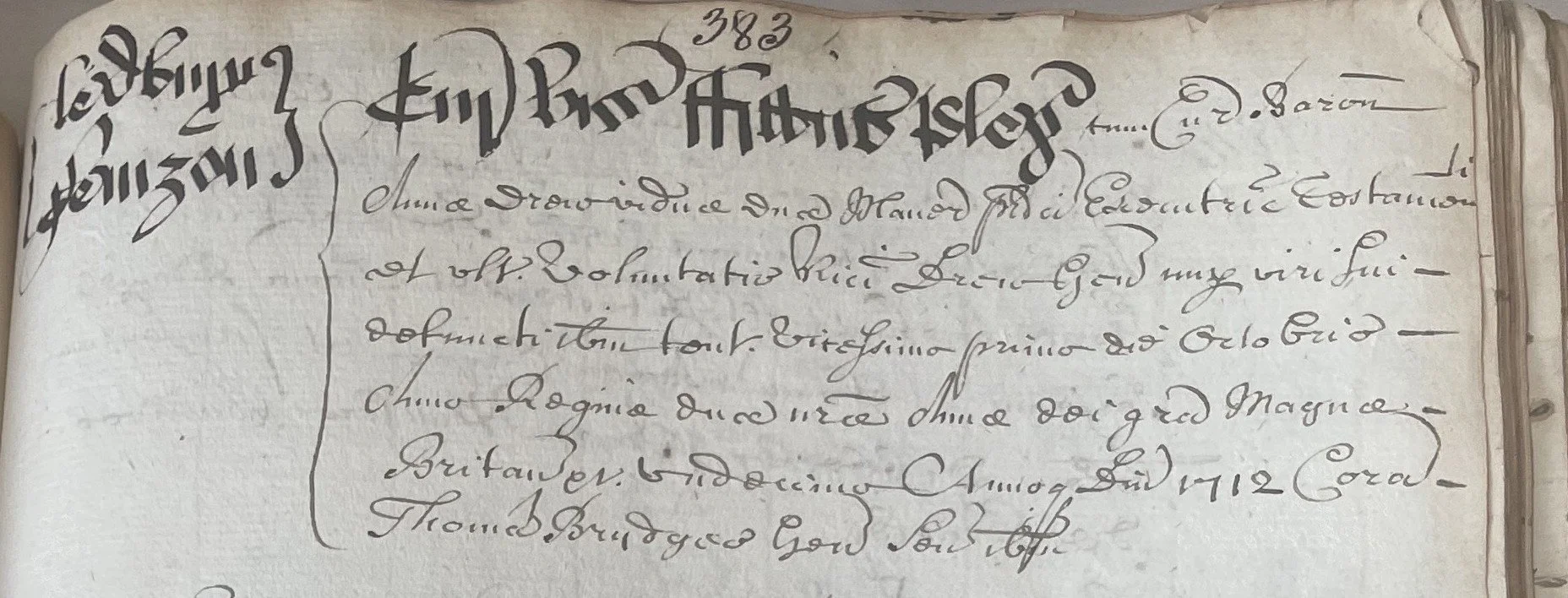
The court baron for Ledbury Denizen, October 1712, in the name of Anne Drew. Source: HARC, AF4/2. Reproduced by kind permission of HARC.
Anne held the Ledbury lordship from 1706 until 1715, likely marking the point at which the old Jacobean leasehold granted back in 1617 finally ran its course. Anne's last recorded court was held on 27 September 1715; Thomas Bridges presided one final time over routine business: a tenant admitted to a messuage in Wellington, fealty done, nothing remarkable. Three days later, on 30 September, a new court was held in the name of John Pytt, with a new steward, Basil Prichard, in the chair. In the space of a long weekend, both the lordship and the stewardship of Ledbury manor changed hands, and Anne Drew, the lord of the manor for nine years, disappeared from its records for good, her story forgotten until now.