The Bishop of Overhall, Ledbury
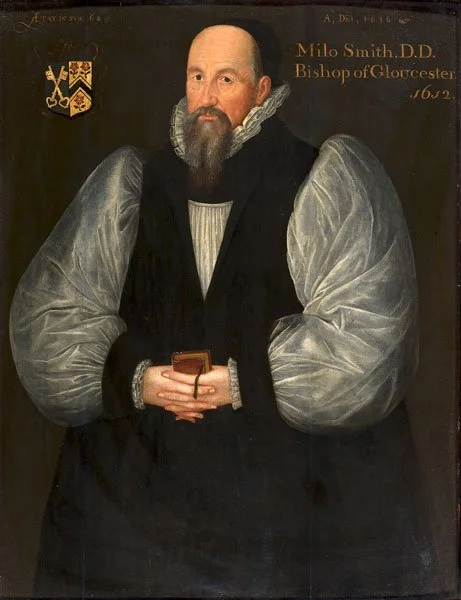
In 1587 a Hereford man was appointed to Overhall, one of the two prebends of Ledbury parish church. His name was Miles Smith, and at the time he was a relatively obscure canon of Hereford Cathedral. However, by his death in 1624, he had become famous across the English-speaking world, though few people in Ledbury today would recognise his name.
Miles was born in Hereford, the son of a fletcher (an arrow-maker, despite the persistent myth that his father was a butcher). He was a prodigy of languages. By the time he was appointed to the Overhall portion, the ancient prebend associated with what is now Upper Hall, he was already known as a scholar of Hebrew, Chaldaic, Syriac, and Arabic. Anthony Wood, the Oxford antiquarian, later wrote that these languages were 'as familiar to him almost as his own mother tongue.'
The Overhall portion was one of the two ancient prebends into which Ledbury's rectory had been divided since at least 1201. As portionist, Smith held the right to the great tithes on cereals and hay and shared with the Netherhall portionist the alternating right to present the vicar of Ledbury. He did not officiate at Ledbury himself; that was the duty of the Ledbury vicar, William Davies. It was a comfortable country living, and Smith held it alongside the vicarage of Bosbury and the rectory of Hampton Bishop, both in the bishop of Hereford's gift. He was also a canon residentiary of Hereford Cathedral, presumably where he spent most of his time.
But Miles’s real significance was to come. When King James I assembled a team of scholars to produce a new translation of the Bible, the translation that became the Authorised Version of 1611 still in use four centuries later, Miles Smith was among the very few outside the universities to be included. He worked on the prophetic books of the Old Testament, and his role did not end there. He served on the final revision committee and was tasked with writing the preface to the entire Bible, which he composed 'in the name of all the translators.' Every copy of the King James Bible for hundreds of years carried at its front the work of Ledbury's portionist of Overhall.
Miles was consecrated bishop of Gloucester in 1612. the year after the Bible's publication, and in recognition, his biographer suggests, of his central role in it. His later years were clouded by a bitter dispute with William Laud, the future archbishop, who, as dean of Gloucester, reordered the cathedral without so much as consulting his bishop. Miles is buried in Gloucester Cathedral. His memorial is there, not in Ledbury. But the next time you open a King James Bible or encounter one of the thousands of phrases from it that have passed into everyday English it is worth remembering that the man who wrote its preface once held the tithes of Ledbury and the right to choose its vicar, though it is a right he never exercised as it never fell due during his tenure, perhaps the reason his connection with Ledbury has passed from memory, until now.