John Aubrey & the Hypothesis of the Terraqueous Globe
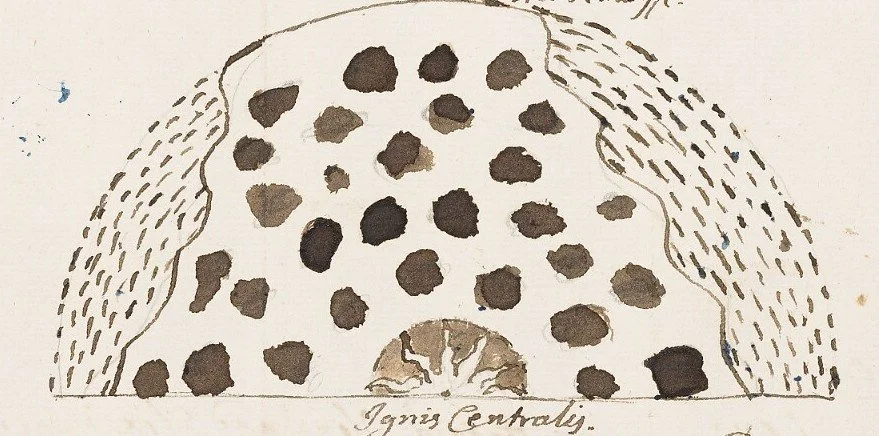
John Aubrey’s sketch of Ignis Centralis, the heat at the centre of the earth, sketch c.1685. Bodleian Library, University of Oxford, MS Aubrey 1, folio 89 recto.
John Aubrey was clever. The first few chapters in his Natural History, particularly his chapter on ‘formed stones’, build to a crescendo in chapter 8, and lead, in the words of the author, ‘to a direct path to the right understanding of the primitive world’. This ‘hypothesis of the terraqueous globe,’ an exploration of early earth history, is carefully unveiled and employs masterful indirection throughout to lead the reader gently to some deeply unorthodox conclusions. And then, with consummate skill, Aubrey applies a balm by engaging with scripture at the close to make the whole hypothesis socially palatable. Here then, Aubrey is at his finest, floating a deeply radical idea while giving himself complete deniability.
When John Britton published his edition of Aubrey’s Natural History in 1847, he chose not simply to edit or abridge this chapter; he replaced it almost entirely with his own summary and commentary, framed in a way to diminish Aubrey’s content; a deliberate editorial judgement that the chapter did not deserve to be read. Britton was a master of condescension. But this is, unfortunately, not all; he also gutted much of the preceding chapters, removing the evidence and theoretical scaffolding that made the burgeoning arguments visible. Aubrey’s careful crescendo became a muddle. The resulting early chapters look like a pleasant collection of local anecdotes.
So, four hundred years after his birth, what did Aubrey say that was so controversial?
The story really begins in Aubrey’s youth, in the area around Chippenham, with the stones he found shaped like cockle shells. ‘I could be angry with my selfe for my stupidity’, he remarked decades later in this chapter, annoyed at himself for walking and riding over these remains in his youth without reflecting on their meaning. But by the Natural History c.1685, Aubrey understood that these were the petrified remains of once living creatures. But, if the stone had once been a shell, then sea creatures had once lived where Wiltshire now stood, miles from any coast. If sea creatures had lived there, the sea had once covered it. If the sea had once covered it, the world would have been radically different from the one described in Genesis. And if some of those creatures could not be found among the living, then God's creation was not the stable, perfect, unchanging order that theology required it to be. It was a deeply controversial view, yet Aubrey held it without apparent anxiety. Throughout his chapter on formed stones, he accumulated fossil evidence: shells at 30 feet depth at Farley, at 60 feet at Brickworth, on mountain tops in Denbighshire and the Alps; never arguing the organic case explicitly but assuming it as established, letting the evidence speak. He shared this position with Robert Hooke, curator of experiments for the Royal Society, up to a point, but Hooke could not say, as Aubrey did, ‘that the world is much older than is commonly supposed, any may be induced to believe from the finding of…’, this was an extreme view in the context of his time, but introduced with a characteristic deflection that would mark everything that followed.
Aubrey's vision of early Earth history began with water. The entire primitive globe, Aubrey argued, was once covered by a universal ocean. The world we now inhabit was, ‘the ruines of an old one’ — battered and reshaped by a long history of catastrophic violence. The flat landscapes that survived: Salisbury Plain, the Hampshire downs, the plains of Picardy, were relics of that original smooth surface. The mountains of Switzerland and Wales, by contrast, looked to Aubrey like countries turned ‘wrongside outward,’ terrain violently disrupted and thrust upward. This is radical, but by the time Aubrey reaches his own voice and his own observations, the reader has already been brought to accept the primitive watery world through the authority of Ovid, and the apparently casual mention of fossil evidence as fact.
The agent of this disruption was earthquakes. Earthquakes, not as isolated events, but a history of catastrophic convulsions that had torn the primitive world apart. And their effects were visible along the coastlines of the world. When the land bridge connecting Dover and Calais was worn away by the sea, Aubrey suggests, the resulting inundation flooded the Low Countries, an event recorded in historical chronicles. And before that, when the land bridge at Gibraltar gave way, the sea poured through into what had been a vast inhabited valley. The people living there ‘thought that the greatest part of the world had been drowned.’ There were no ‘historiographers’ in those days to record it, and so the catastrophe became myth. Noah's flood, in Aubrey's quiet implication, was the cultural memory of a real geological event. Aubrey explores the evidence for these earthquakes, deploys classical quotations and cites Robert Hooke, but he never draws the connecting argument together; that synthesis is left entirely to the reader.
Driving all of this was what Aubrey called Ignis Centralis, central fire. At the heart of the earth burned an ancient and intense heat, just as the heart warms the body, a circumstance that Aubrey assured his readers was ‘the most commonly received opinion.’ This explained everything: volcanic eruptions, the hot springs at Bath, the self-renewing metal mines of Cornwall, even the formation of hills, pushed upward from below like blisters rising in bread by gases trapped beneath the surface. Aubrey had seen a small version of the central fire himself. On St Andrew's Day 1666, riding toward Gresham College with some of the most eminent natural philosophers in England, he peered into a cellar at Holborn Bridge where labourers were clearing Great Fire rubble. The coals were still burning, alight since September, three months earlier, sealed from the air, consuming almost nothing. If coal could sustain fire underground for months, what might be burning deep in the earth, sealed for millennia?
And if those fires had burned for millennia, the Earth was old. Much older than Genesis allowed. Aubrey never quite said this directly. Instead, he measured grass. A causeway at Houghton Conquest in Bedfordshire, neglected since 1654, lay buried under nine inches of soil by 1687, accumulated through nothing more dramatic than grass rotting upon grass over thirty-three years. Nine inches in thirty-three years. He offered no calculation. He did not need to. Any reader who thought about the Roman causeways buried yards deep beneath Salisbury, or the stratum upon stratum of rock visible wherever men dug, could reach the conclusion Aubrey had so carefully declined to state.
The chapter closes with Aubrey’s engagement with scripture: Genesis and Paul's Epistle to Timothy. But this is not an attempt to reconcile his geology with the Bible’s text or to use scripture to bolster his argument; it is protective framing, a placebo applied to make the whole hypothesis acceptable. An observation, for example, that the Apostle ‘doth not say to teach natural philosophy’ quietly separates the domains of faith and natural inquiry so cleanly that nothing Aubrey proposed could, arguably, be condemned as unorthodoxy, because that required a conflict between natural philosophy and scripture. Scripture taught salvation. Natural philosophy reads the Earth. They were different books. And, as ‘Pere Symond’ said ‘scripture in some places may be erroneous as to philosophie; but the doctrine of the church is true.’
Nonetheless, all of this pointed toward a conclusion that was as theologically unsettling as it was intellectually exciting. The earth was not a stable, perfect creation handed down unchanged from the six days of Genesis. It was, in Aubrey's vivid phrase, the ruin of an old world; battered, reshaped, and still changing. Aubrey ended his chapter with Ovid's prophecy that a time would come when sea, earth and sky would all be consumed in fire, and the great labour of the world would at last be at an end. It was a vision of the earth as a living, dynamic, ageing thing; born in water, shaped by fire, fated eventually to burn out like a dying comet. For a man writing in the 1680s, it was an extraordinary thing to imagine. It was also extraordinarily written, the subtlety and brilliance lying precisely in the incompleteness and associative structure of his argument. A more finished, systematic treatise that made claims about the age of the earth and the fallibility of Genesis would have made Aubrey a target. This chapter, full of observations, classical quotations, earthquake reports, and suggestive speculation, was much harder to attack, and the reader was quietly brought to Aubrey’s radical vision. It was, in the author’s view, the best thing in the Natural History, and I am inclined to agree.