John Aubrey’s Natural History, Part 6: The Network of Knowledge
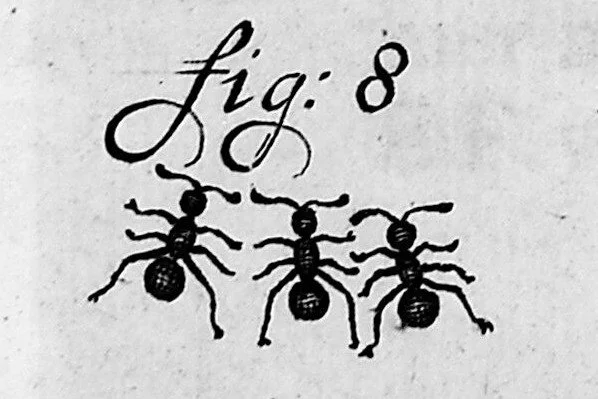
In John Aubrey's chapter on reptiles and insects he quoted a remedy for ague (a fever marked by recurring chills, sweating and shivering) that used an egg boiled in the patient's urine until it went blue, pricked full of holes and buried at the base of an anthill. This cure used sympathetic magic, the belief that objects connected to a person (such as their urine) could be used to transfer their illness to another object (the egg), and that what happened to that object would happen to the person. And so as the ants consumed and destroyed the egg buried in the anthill, the disease was simultaneously consumed and destroyed in the patient's body. This 'receipt', as Aubrey referred to the medical remedies that peppered the manuscript, was attributed to Captain Hamden, half-brother of the poet and Royal Society fellow, Edmund Waller, who had used it with some success. But, perhaps to give it added credibility, the cure was cross-referenced with the work of Oswald Crollius (c.1563–1609), a German alchemist and physician, and Robert Boyle, founder member of the Royal Society and pioneer of experimental chemistry.
This chapter is one of the shortest in Aubrey's Natural History of Wiltshire, yet it provides a perfect lens for considering how Aubrey gathered the knowledge he wove into his great work. The Natural History is not just a record of Wiltshire but a map of his entire intellectual world — stretching from royalty, courtiers and the founding Fellows of the Royal Society to farmers, country clergymen, and Mistress Hatchman, who made excellent metheglin. At a moment when the Royal Society was establishing what counted as authoritative knowledge and who had the right to produce it, Aubrey's instinct was to cast the net as wide as possible.
Looming large in that world was the Royal Society itself. Aubrey was an original Fellow, elected in 1663, and this chapter reads like a rollcall of the Society's founding generation. Robert Boyle had been one of the twelve men present at the Society's inaugural meeting at Gresham College, London, in 1660. Christopher Wren had delivered the lecture that prompted that first gathering. Robert Hooke, experimental philosopher and polymath, appears in the chapter as the designer of an ingenious beehive model that Aubrey was eager to obtain a copy of in March 1684/5. John Pell, mathematician and clergyman, is Aubrey's named source for the properties of the shed skin of adders. Francis Potter, inventor and rector of Kilmington in Somerset (now in Wiltshire), contributed careful experimental observations on bees. Thomas Willis, physician and anatomist, is cited for an extraordinary remedy using calcinated toads against plague and pestilential fevers. These men were not distant authorities Aubrey cited respectfully from afar. They were friends, correspondents, and colleagues, and their contributions to this chapter arrived through years of conversation, letter-writing, and the kind of generous intellectual exchange that the Royal Society existed to encourage.
Knowledge moved through place as much as through people, and the geography of this chapter is as revealing as its cast of characters. Contributions are woven from Wiltshire and across England and Wales- Sussex, Oxfordshire, Hampshire, Cambridgeshire, Dorset and more. Attribution is given, but sometimes not; information is sometimes cross-referenced, ambiguity is noted, and questions are recorded to follow up with specific individuals. Christopher Wren's contribution carries a specifically Wiltshire flavour. Aubrey noted Wren's father, the rector of East Knoyle, had a neighbour in Knoyle who developed leprosy following an adder sting; possibly this reached Aubrey through those local family connections.
From Glamorgan, Aubrey noted Dr Jones frequently ate adders and made broths of them, and further, 'Hee was a sanguine man and of a franke humour, and protested to me, voluntarily, in the rode, that it did wonderfully conduce to the curing of his clappe'. Information from Jones was given voluntarily in the road, a confidence while travelling the same route, perhaps. Information passed by word of mouth, other material Aubrey gathered from print and correspondence, or things remembered or personally observed. The Rev. Andrew Paschall, rector of Chedzoy in Somerset and a Fellow of the Royal Society, is mentioned for his ingenious contrivance for keeping bees inside his rectory. Paschall's letters to Aubrey survive in the Royal Society archives, including one on the topic of beehives.
Oxford was important in Aubrey's knowledge network. The Moroccan ambassador to Charles II, Muhammed ibn Haddu, relayed a remedy for gout involving ground-up snails to Elias Ashmole while visiting Ashmole's collection of rarities in Oxford. This remedy 'much used' in Africa was set down by Aubrey after contact with Ashmole; an international perspective recorded in a Wiltshire natural history. Robert Plot, keeper of the Ashmolean collection and author of natural histories of Oxfordshire and Staffordshire, is cited twice in the bees' section, another Oxford connection feeding comparative knowledge into Aubrey's Wiltshire observations.
Knowledge flowed not through formal institutions alone but through personal connection, social trust, and the free exchange of curiosity across the boundaries of court, college, country house and street. Yet for all the potential grandeur of his network, some of Aubrey's most telling observations came from people whose names history would not otherwise have preserved. Goodman Abraham, a farmer at Compton Chamberlayne, is cited by name as a reliable witness to the abundance of snakes in the local woods, his testimony treated as evidence on equal terms with that of men of higher social status noted in the neighbourhood. The saltpetre men, working men who collected urine-soaked earth and manure to create saltpetre, are recorded as possessing genuine practical knowledge worth setting down. Mistress Hatchman's metheglin is rated equal to the best in Devizes and is set down alongside another recipe from Sir Edward Bayntun, one of the most powerful men in the county. The Natural History of Wiltshire is the product of an extraordinarily connected mind. Aubrey gathered the world into a Wiltshire notebook one conversation, one letter, one chance encounter at a time. When it is published in 2026, four hundred years after Aubrey's birth, readers will encounter it complete for the first time and will find that the anthill remedy, the Moroccan ambassador's snail plaster, the under-sawyer of Broad Chalke, and the Fellows of the Royal Society all belong, unremarkably and deliberately, in the same place.