The Featherless Goose of Bradenstoke: A 17th-Century Tunnel Tale
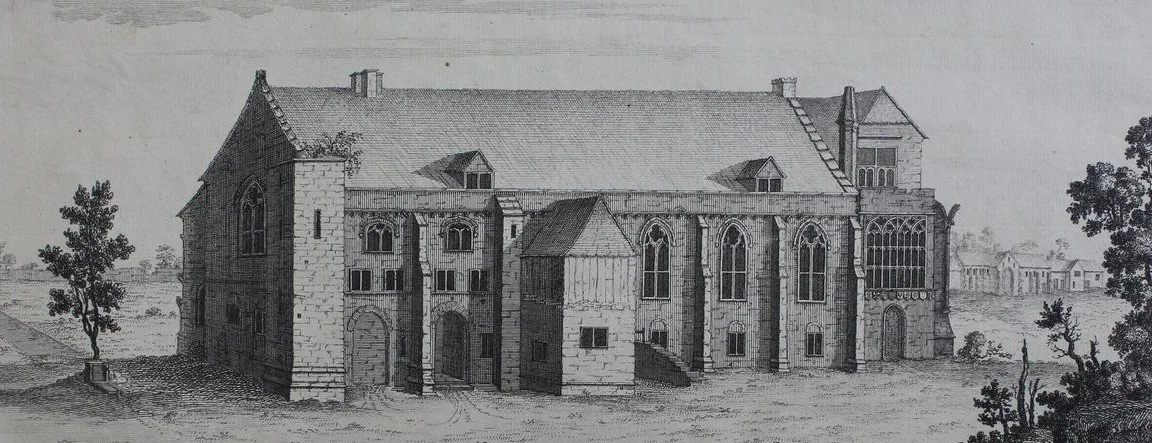
Bradenstoke priory was a wealthy Augustinian foundation about six miles from Malmesbury. When John Aubrey visited the ruins in 1666, he found impressive remains, particularly a vault under the former refectory, which he contended was ‘the stateliest’ cellar in Wiltshire. Aubrey described it at length, the detail of which down to the presence of a spring and subterranean water trough is substantiated by later archaeological investigation. But possibly the most remarkable feature of the priory was one Aubrey could not see, because its entrance was stopped up with rubbish; a vault that lay under the king's lodgings, the priory’s guest accommodation which had once welcomed the likes of King John. This vault Aubrey was told ran all the way to Malmesbury abbey and passed beneath the River Avon.
More than five miles. Under a major river. In the Middle Ages.
Even by seventeenth-century standards, this should have raised doubts. But local people claimed that to test the tunnel's existence, a goose had been ‘put in’ it and the bird had emerged out of the vault again several miles away ‘without feathers at a well near Sutton Benger.’
The story seems absurd. A goose entered a vault at one end, travelled miles through darkness, and emerged completely bald at a village well. No explanation is given for the missing feathers or how the featherless goose was identified with the one who entered the tunnel, or how long its journey took, or what the goose encountered, or why anyone thought this was a good experimental method.
The geography of the journey is also questionable. Had the subterranean vault continued to Malmesbury the most direct route would be a line northwest passing under the river around Lower Seagry. To get to Sutton Benger, the vault would, instead, have gone westwards, before heading northwards, thus substantially increasing its length and necessitating passing under the river at least twice more than necessary. And Sutton Benger does not lie directly on the Malmesbury Road either.
Stories like this are common. Dissolved monasteries across England spawned similar legends – another tunnel (although this story was recorded much later) supposedly connected Kington St Michael priory (a Benedictine convent) to Malmesbury abbey (a Benedictine monastery). The often impossibly long passages recorded in these tales connected not just abbeys and priories, but houses, castles, churches, inns and monuments. Stories sometimes record tunnels being tested by sending in drummer boys or dogs who disappear into the darkness, never to be heard of again. The origins of these stories may be misremembered drainage systems, cellars, or pure folklore. The Bradenstoke story fits a pattern perfectly, with one delightful exception: most tunnel legends do not involve waterfowl losing their plumage.
Aubrey recorded the anecdote without comment and thereby preserved what the locals said, leaving his audience free to make their own conclusions about its plausibility. He did not explicitly say he disbelieved them. But Aubrey’s reporting was careful. He saw the entrance to the vault and clearly anticipated a significant chamber lay beyond. And, indeed, the remains of a vaulted cellar are in evidence today. Aubrey loved a story too, and a test might have conceivably been attempted decades earlier by local people to make sense of a mysterious undercroft at the former priory. It was a tale too good to lose, even if he probably did not believe it. And he was right because this is certainly a story I felt compelled to retell.