The Herberts' Chymists
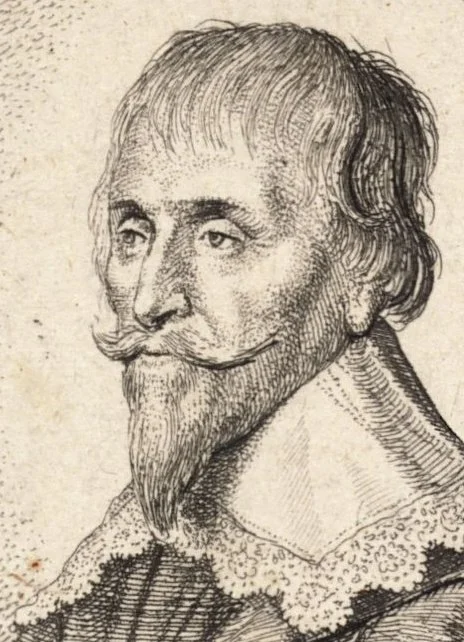
John Huniades (János Bánfi Hunyadi), after Gowy. 1644.
Wilton House, Wiltshire, the seat of the Herberts, Earls of Pembroke, was once home to an alchemical laboratory.
It likely began with Mary Herbert (1561-1621), Countess of Pembroke, a woman, according to John Aubrey in the Natural History, whose genius lay ‘as much towards chymistrie as poetrie.’ She was, Aubrey wrote elsewhere, ‘a great chymist’ who ‘spent yearly a great deale in that study’. She kept Adrian Gilbert, half-brother to Sir Walter Raleigh, as her ‘laborator’, her laboratory assistant. Aubrey thought him ‘a man of great parts, but the biggest buffoon in England.’ Among those to whom Mary paid a pension was Mr Boston, a Salisbury brewer's son and ‘a good chymist’, whom she would have retained at Wilton (perhaps in Gilbert's place) had he been willing; but he refused, wanting all the gold to himself, and, obsessed by transmuting base metals to gold, evidently undid himself in the search for the Philosopher's Stone. According to the Natural History, when his laboratory was opened after his death, baskets of eggshells were found; an ingredient, Aubrey noted, that ‘Geber’, the 8th-century Islamic alchemist Jabir ibn Hayyan, named a principal constituent of the Stone. These were not the diversions of a literary household, for which Wilton is better known, but a sustained programme of practical ‘chymistry’, a term that covered both chemistry and alchemy, paid for annually and staffed by named men, running at Wilton for a generation before the Royal Society existed. This aspect of Mary Herbert's life is little known. But what came next has, I think, gone largely or even wholly unremarked.
Mary’s sons William and Philip succeeded to the title in turn as the 3rd and 4th Earl. Neither appears in Aubrey’s account to have inherited their mother’s interest in chemistry or alchemy, or at least Aubrey does not list them amongst their attributes or interests. But Mary’s grandson, Philip (1619-1669), who inherited the title as 5th Earl of Pembroke in 1650, was different. Philip had an admirable wit; he was contemplative, and his ‘chiefest diversion was chymisterie, which his Lordship did understand very well’. If Aubrey is to be believed, Philip was first informed of the art by John Huniades (also known as János Bánfi Hunyadi) (d.1646), a Transylvanian whom Aubrey described as born to a great estate and forced to flee. Given the date of Huniades’ death, he must have instructed Philip as a young man before he came to the title.
It is known that Huniades came to England around 1608 and settled in London, where he initially worked as a goldsmith. He prospered but moved into chemistry and alchemy. And in so practising according to Aubrey, ‘brought chymistry in reputation in England, which before had been in disgrace by cheates, and montebankes.’ Huniades taught his craft to the natural philosopher, Sir Kenelm Digby, the Roman Catholic priest and scholar, Thomas White and Sir Andrew Coggan, charging each and many more substantial sums, but through which, Coggan at least ‘got a good estate by it in the East Indies.’ Huniades’ standing in London is clear enough from the fact that in 1645 William Lilly, the most famous astrologer in England, dedicated his almanac Anglicus, Peace or no Peace to him, styling him a searcher into hermetic philosophy and a practised professor of the spagyric art and thanking him for having ‘besprinkled the understanding of many of our countrey-men with some of your curious conceptions.’ Aubrey thought the dedication worth copying into the Natural History at length.
From the early 1630s Huniades worked at Gresham College in London, the chief centre of scientific activity in the city and the institution out of which the Royal Society would grow. In 1633, Prince George Rákóczi invited him back to Transylvania to take a professorship at a college he was founding at Kolozsvár, but Huniades stayed in London. He stayed because he believed he was close to something, a breakthrough in alchemy.
Huniades’ alchemy rested on the principle that all metals shared one essence and differed only in their 'accidents': their colour, weight, hardness and lustre, the outward qualities that make lead look like lead. Mercury, according to Huniades, was that essence laid bare: prime matter, the undifferentiated stuff of which all metals are made. Est in Mercurio quicquid quaerunt sapientes, ran his watchword: whatever the wise seek is in mercury. Strip a metal of its accidents and what remained was prime matter, ready to take on new qualities. The achievement he was proudest of is recorded beneath his engraved portrait of 1646: he had destroyed gold and silver by mercury, reduced them into a mercury by mercury, and then, adding nothing further, precipitated that mercury into a red powder. In the portrait, he holds up the glass vessel in which it was achieved.
How a Transylvanian chymist at Gresham College came to inform a young Philip Herbert in the art, Aubrey does not say. What is certain is that the connection outlasted the teacher. Huniades died suddenly at Amsterdam on 28 August 1646, where Arthur Dee, son of John Dee, was to join him on an alchemical quest to Hungary. According to the Natural History his son John, born in 1621, came to Wilton as chymist to Philip, 5th Earl of Pembroke, on a pension of a hundred pounds a year, and was, Aubrey said, 'extremely beloved by his Lordship'. He was still alive in 1689, a bachelor worth at least twenty thousand pounds, much of it from a scarlet dye his family claimed as his father's invention, a recipe he kept secret, but which Aubrey copied into the endpaper of Pliny's Natural History.
By 1669, the 5th Earl was dead, but Aubrey continued to use Huniades junior as a source for Wilton: what had been painted on the ceiling that had burnt, what the 4th Earl had paid Van Dyck for the family portrait, and what his income was. His association with the family was close, but, frustratingly, Aubrey says little directly about Huniades’ work at Wilton; although his writings show the connection continued. Writing to Anthony Wood in October 1688 Aubrey looked forward to 'the society of an old acquaintance' who, he thought, could tell him a hundred things more than Thomas White or Robert Boyle, often called the father of modern chemistry, and who was, he believed, 'of the family of the Kings of Hungarie'. Aubrey's Faber Fortunae, written c.1689, a list of money-making schemes with which Aubrey hoped to revive his fortunes, shows the younger Huniades still moving in the same sphere as the Herberts: he told Aubrey where to take his ore to be assayed, and warned him that the Earl of Pembroke’s marcasite would come to nothing and was dangerous besides, as it was so full of arsenic. Huniades further warned that a ‘cheat’ had been put on the Earl. The Earl in question was now Thomas, the eighth Earl of Pembroke, whom Aubrey wanted to ask about his own method of analysing marcasites and the man to whom Aubrey dedicated his Natural History.
Huniades died in November 1696, in his seventy-fifth year, leaving everything to his sister Elizabeth. She had him remembered on his tomb as an ornament of the spagyric art and a man of untouched integrity. Others called him vir sordidissimus et avarissimus (the most sordid and most avaricious of men). Between them, father and son had made out of chymistry a fortune of twenty thousand pounds.
For this blog, I read more widely than Aubrey’s Natural History (Royal Society MS 92), and thus I am indebted to the work of Kate Bennett, Martyn Rady, and to F. Sherwood Taylor, C. H. Josten and John Appleby in Ambix.