John Aubrey’s Natural History, Part 2: The Lost Species of Dinton
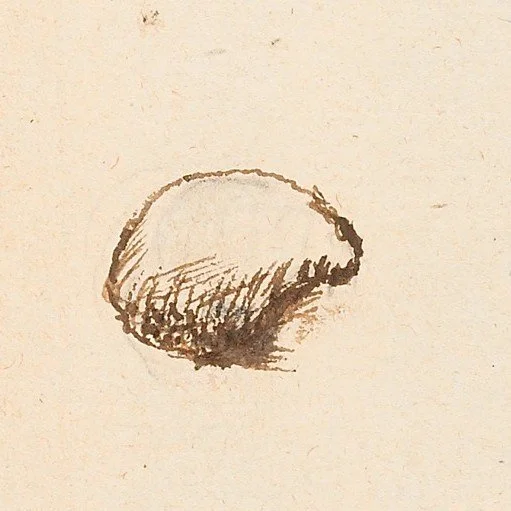
John Aubrey’s sketch of a Dinton petrified shell c.1685. Bodleian Library, MS Aubrey 1, folio 17 recto.
In the hills around the village of Dinton in Wiltshire’s Nadder valley, John Aubrey discovered an abundance of ‘perfect petrified shells’ that resembled cockles, but were ‘neither striated, nor invecked; nor any counter-shell to meet, but plaine and with a long neck, of a reddish gray colour’. Some twenty years before writing his Natural History, Aubrey gathered specimens and presented them to the newly created Royal Society in London. His frequent collaborator, Robert Hooke (1635-1703), the curator of experiments at the Royal Society, presumably examined them carefully, as Hooke informed Aubrey the species was ‘now lost.'
This ‘lost’ species had become fossilised in the landlocked hills of Wiltshire. In the context of the 21st century, these observations may seem unsurprising, but the Dinton shells posed profound questions for 17th-century natural philosophy. Even if it was accepted that these stones were the remains of sea creatures, how did they end up fossilised in the Wiltshire hills, miles from any coast? And, probably more troubling, what did it mean for a species to be 'lost'?
Aubrey noted similar finds at Cocklebury near Chippenham, Wiltshire, where rough stone was 'all cockles petrified', and many more examples across the neighbouring Malmesbury hundred. These were not isolated curiosities but widespread geological features that demanded explanation. For many of Aubrey's contemporaries, fossils were either lusus naturae, a joke of nature, stones that just happened to look like shells or evidence of the Biblical flood. Yet, within the pages of his Natural History there was never any doubt in Aubrey’s mind that these were the genuine remains of a once living organisms. However, when Hooke declared the Dinton shells belonged to a species 'now lost', he was proposing something else too: extinction.
The concept of extinction was theologically difficult. If God had created a perfect world, how could any part of that creation simply vanish? The dominant view held that all creatures mentioned in Genesis still existed somewhere. To suggest otherwise implied either that God's creation was imperfect or that the natural world was mutable and subject to huge changes. Yet Aubrey recorded Hooke's opinion without evident anxiety or attempt to soften its implications. He simply noted the expert testimony. Aubrey’s matter-of-fact acceptance reveals much about his approach to natural philosophy. He was not constrained by what should be true according to theological doctrine; he documented his observations and those of collaborators, though the pages of the Natural History show he did so critically. Aubrey was not merely a collector of curiosities, a purveyor of tittle-tattle and consumer of fanciful ideas on the preternatural as has sometimes been suggested. He was open and receptive to the latest scientific theories. He was an active participant in the collaborative enterprise of the early Royal Society, where empirical evidence gathered from across England fed into larger theoretical debates about the nature of the Earth. Aubrey expressed Hooke’s view on the species of the Dinton cockles because he was convinced.
Within the structure of his Natural History, Aubrey placed his Dinton observations in his introduction between a discussion of current flora and an analysis of human 'Complexions' or temperaments. This was not random. He was building an argument about environmental forces shaping all living things across vast timescales. If seas could become hills, if species could be lost, then the environment that shaped human character was itself mutable and ancient. These ideas are developed in later chapters, and presented the most controversial sections of the manuscript, but critically they are also those elements of which Aubrey was most proud.