John Aubrey’s Natural History, Part 3: Are Dragons Real?
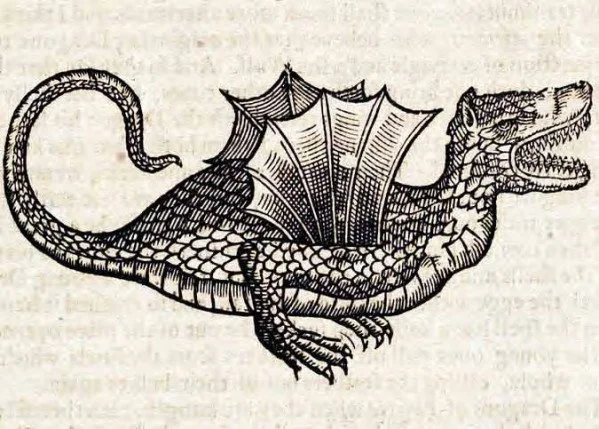
Winged Dragon by Edward Topsell, 1658.
Are dragons real? They appear in several places in the Natural History. 'Though it be foreign, as to Wiltshire, I will here by speake of the wiverns,' Aubrey remarked in his chapter on birds, possibly considering the wyvern, a particular type of two-legged dragon, more closely related to birds than the mammals, reptiles, or fish he described in separate chapters. Samuel Purchas, a travel writer, claimed that wyverns were swan-sized, fed on monkeys, and lived in the Atlas Mountains in North Africa. For Aubrey, this was not enough proof. It needed testing. Aubrey sketched a wyvern from a coat of arms and enclosed it in a letter to Wyld Clarke, a merchant who had travelled widely in North Africa. Clarke's accounts pepper several of Aubrey's works; having spent fifteen years in Africa, his experience was invaluable on topics as diverse as hurricanes, the culinary and medicinal value of porcupines and the best method of using henna to dye hair. Aubrey asked Clarke to make enquiries. Clarke obliged his friend and travelled 'farther in the country than any Christian before him: and he could heare no newes of any such creature.' Thus, concluded Aubrey, the wyvern was a 'vulgar error.' Scientific investigation had debunked a myth.
Aubrey's engagement with dragons did not stop with the wyvern. In his chapter on 'beastes', he recorded another dragon entirely, one painted on a church wall in Mordiford in Herefordshire, and very much alive in local memory.
But he began the account with careful framing, Sir Henry Blount had once observed, "Twas pitty to spoile a story for leaving out of a word, or two." Stories got better with embellishment. He continued, 'On the outside of the chancel at Mordeford in Herefordshire is painted a serpent almost as long as the breadth of the wall. It hath now four pairs of wings.'
Above the painting were lines of verse:
A valiant act indeed and donne by him alone whose name is Gerson. Anno Domini 15…
Someone called Gerson, sometime in the reign of Mary I, had apparently dispatched the serpent-shaped dragon. Aubrey noted that the Gerson family were still in the parish and 'every time the church is painted, they renew this serpent.'
Aubrey had seen the painting on an earlier visit, and he remembered something precise and telling: there had been fewer pairs of wings then. Wings had been added. The dragon was growing.
This was the kind of observation that separated Aubrey from less careful witnesses. Where another might simply have recorded the legend and moved on, Aubrey noted the discrepancy between what he remembered and what was now on the wall, identified it with a family who had an interest in perpetuating and aggrandising their ancestor's reputation and drew a conclusion quietly but firmly.
'I add this also,' he wrote, 'to shew how apt the world is to be imposed upon even in things against nature and against the staticks.' Statics is the science of weight and equilibrium. The point was not only that the dragon was zoologically improbable, but also that four pairs of wings on a body that size was mechanically absurd and would remain absurd even if serpents could fly. The credulity Aubrey targets is so complete that it accepts things violating two separate orders of knowledge at once.
Aubrey did not assert that a serpent-shaped dragon was not killed at Mordiford, or that a Gerson was invented. His claim was more nuanced and evidenced: this representation had demonstrably grown, and its growth followed the direction of family interest rather than fact. This was not a blanket denial of the existence of dragons. So, to the question: do dragons exist? For Aubrey, the question was open.
Text updated 30 Jul 2026.