Wenceslas Hollar & the Two-Headed Serpent
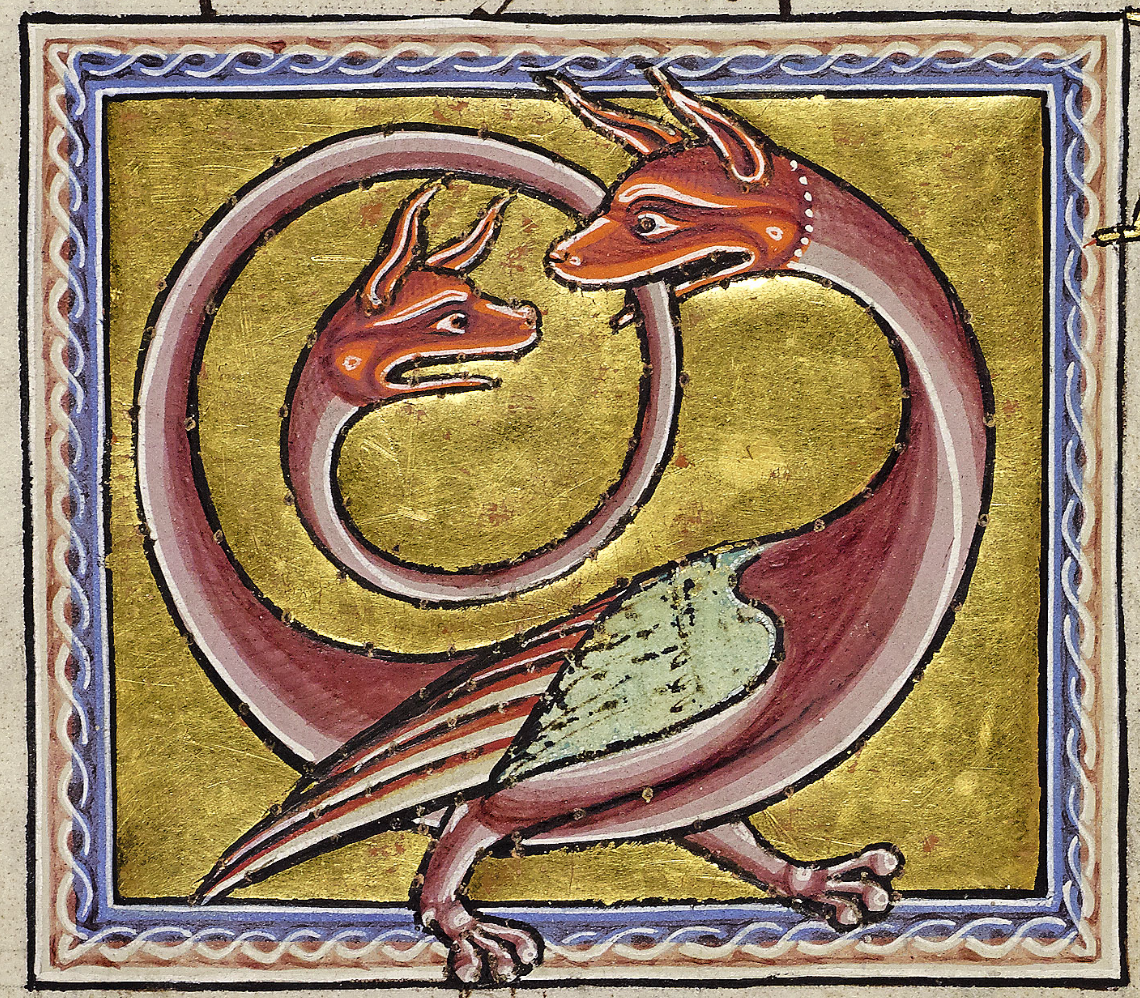
Amphisbaena. Miniature from the Aberdeen Bestiary, folio 68V. 12th century. Public Domain.
Wenceslas Hollar (1607-1677) was a gifted etcher and painter, a friendly and good-natured man, but he lacked the cunning (according to John Aubrey) to make a financial success of his talent. The Czech emigrant made a life in England during the Civil War period and observed firsthand the political tumult and the change war wrought in the English, remarking ‘that when he first came into England…the people, both poore and rich, did looke cheerfully, but at his returne <after a period in the Low Countries>, he found the countenances of the people all changed, melancholy, spightfull, as if bewitched.’
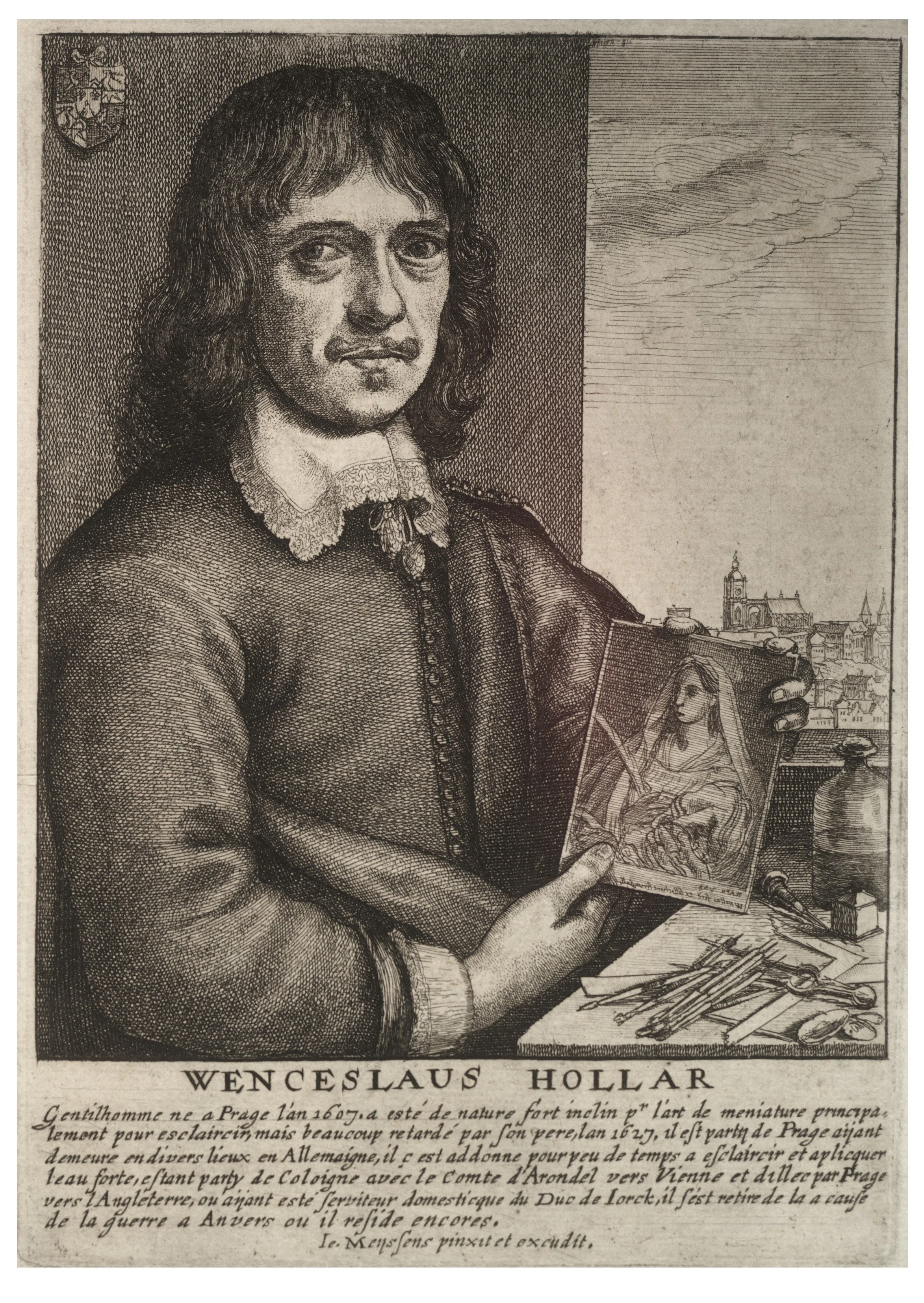
Portrait of Wenceslas Hollar etched by Hollar after an original by Jan Meyssens c.1649. Public Domain.
During his working life, Hollar made two images of an amphisbaena, a mythical two-headed serpent that had come down from Pliny and the bestiaries: a serpent that could travel in either direction and was thought to be venomous at both ends. By the seventeenth century, educated opinion had filed it with the phoenix and the basilisk.
The first image Hollar made at thirty-six, at the height of his powers, a Royalist artist in a garrison turning out plates at a furious rate. An allegory of civil strife entitled Civilis Seditio, it was an etching that depicted the heads of the serpent straining in opposite directions before the sphinx and pyramids; ancient, everlasting monuments, and a creature busy tearing itself apart. The second was a small watercolour, apparently from life, that ended up in the collection of a courtier at Whitehall and for which the hapless Hollar was never paid.
Civilis Seditio is in the Royal Collection. The watercolour of an amphisbaena 'the colour of the inner peele of an onyon' is known to us, in all likelihood, only from John Aubrey's description of it in his Natural History of Wiltshire, at the tail end of a discussion of intestinal worms. The imaginary one survives; the one drawn from life does not.
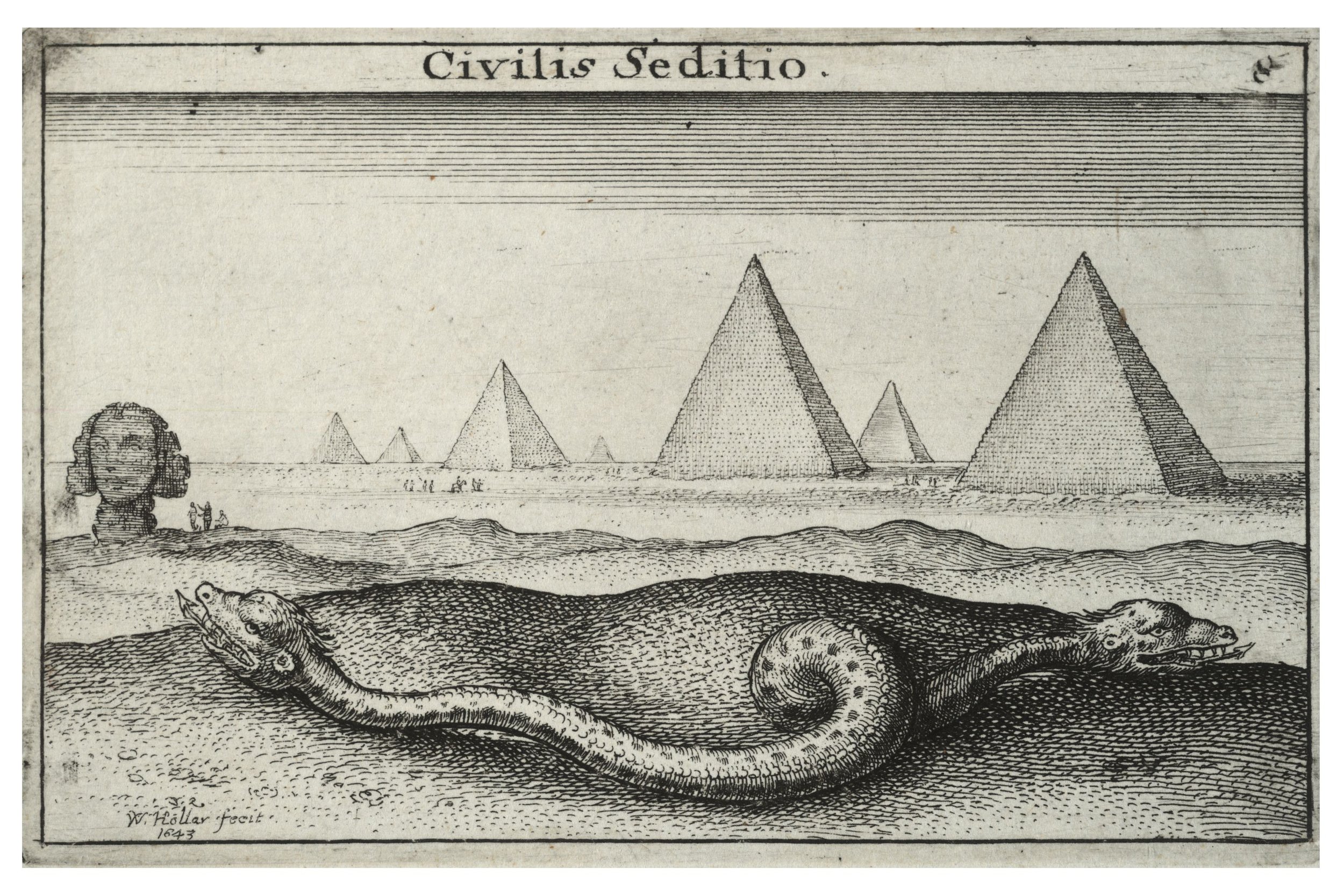
Civilis Seditio etched by Wenceslas Hollar, 1643.
Aubrey had known Hollar since his own university days at Oxford and had given the artist several commissions and recorded his story in a brief life, one of the biographical vignettes for which Aubrey is best known. However, Hollar’s interaction with an amphisbaena did not form part of that biography, despite its strangeness, and aspects of the story are a little off.
According to Aubrey’s natural history notes, Hollar encountered the creature in the city of Mechlin (Mechlen), now in Belgium, about 1661. It had been ‘found under a piece of old timber’, and thereafter he had ‘very curiously’- precisely and carefully- delineated or drawn the amphisbaena, and coloured it in with watercolours. The creature was depicted in the ‘figure of a semi-circle, both the heads advanceing equally.’ Under the creature’s jaw were barbs, fleshy filaments hanging round its mouth, which ‘did strengthen his motion in running’. But, although the description suggested something disturbing, the creature was small, bearing the proportions of a slow worm. And Aubrey concluded, ‘I guesse, it was an amphisbaenal sloworme.’ A monster demoted, in this assessment, to an anomalous individual of a known species.
Despite Aubrey’s decisive take on the creature, questions remain. In Hollar’s Brief Life, Aubrey recorded the artist spending much of the war in the Low Countries before returning to England around 1649. As far as I can ascertain, there is no other evidence for Hollar’s presence in the Low Countries after 1652. Perhaps the amphisbaena was found earlier, in the mid-late 1640s, but although Aubrey was sometimes not the most precise temporal witness, the difference is significant. And Aubrey observed that the painting was with Thomas Chiffinch, the Keeper of the King's Closet, who held the role at Whitehall only from the Restoration in 1660 until his death in 1666. So, the failed transaction between Chiffinch and Hollar for a watercolour of a two-headed serpent dates to the 1660s, and either the drawing was made in the 1640s and only passed to Chiffinch twenty years later, or Hollar was in the Low Countries around 1661, and nobody recorded it.
I find Hollar’s two amphisbaenas fascinating. One survives as an image we can look at, but the creature in it was never seen. The other was a real creature, carefully drawn and coloured, but the image is gone; that makes me a little sad. Hollar gave the image away for nothing, and it appears to be unrecorded, to my knowledge at least. Though perhaps there is hope. Hollar’s images survive in quantity; maybe at Windsor Castle or the British Museum or elsewhere, there is a small pale watercolour described as an eel, worm or even a slow worm, the colour of an onion, which, if someone should only look at it closely, they would see a head at either end.